Focus Area: Crop Protection

  • It’s time glyphosate discussion returned to facts based on science

    Comments Off on It’s time glyphosate discussion returned to facts based on science

    A number of glyphosate-focussed stories have appeared in the media this weekend.

    Most of these articles fail to reference that agricultural chemicals, including glyphosate, are some of the most regulated products in the world.

    The world’s most sophisticated, advanced, independent and scientifically-competent regulators have assessed and reassessed glyphosate and declared it to be safe.

    In 2016 the Australian Pesticides and Veterinary Medicines Authority (APVMA) comprehensively reviewed the IARC report and found no grounds for glyphosate’s approved uses to be reassessed.

    Last month the United States Environmental Protection Agency (EPA) reaffirmed the safety of glyphosate, finding it is not a carcinogen. Their Glyphosate Proposed Interim Decision found there are no risks to public health when glyphosate is used in accordance with its current label.

    In January this year, Health Canada re-confirmed their position on the safety of glyphosate saying, “Our scientists left no stone unturned in conducting this review.”

    The European Food Safety Authority have stated, “Glyphosate is not classified or proposed to be classified as carcinogenic or toxic…”

    Local councils and state departments have a responsibility to their residents and employees and should review the use of weed management tools to ensure they are being used and managed correctly. However, we cannot allow ambulance chasing litigation law firms and anti-chemical activist groups to warp what is a highly regulated industry that provides products crucial for Australian farmers to deliver safe, disease-free and nutritious food.

    Without pesticides, like glyphosate, we would not have access to nearly enough produce to feed our nation, let alone contribute to feeding the world.

    These chemical products play a critical role in environmentally sustainable farming practices around the world. The application of glyphosate eradicates pests without having to disturb the soil and disrupt the weed’s roots via tillage which can reduce soil erosion by up to 90 per cent, significantly improve water retention and increase/maintain carbon storage.

    The community has a right to be informed about glyphosate, but it’s crucial they are informed by the experts. Governments must ensure that the proven and established science of chemistry prevails, so farmers continue to have access to the very best in agricultural tools and technologies.

    For more information visit: croplife.org.au/glyphosate
  • The science of glyphosate remains unchanged

    Comments Off on The science of glyphosate remains unchanged

    Decisions by juries in civil litigation cases in the United States that disregard science do not undermine the independent scientific evidence regarding glyphosate safety and must not be allowed to warp public policy or regulatory decisions on agricultural chemistry. The world’s most sophisticated, advanced and scientifically competent regulators have declared glyphosate safe and more than 800 scientific studies and independent regulatory safety assessments support the fact that glyphosate does not cause harm to humans or the environment.

    Earlier this month the United States Environmental Protection Agency (EPA) reaffirmed the safety of glyphosate, finding it is not a carcinogen. Their Glyphosate Proposed Interim Decision found there are no risks to public health when glyphosate is used in accordance with its current label.

    The US EPA’s cancer evaluation is more robust than that done by the International Agency for Research on Cancer (IARC) as the US EPA used 15 carcinogenicity studies in its evaluation, almost double the number of studies considered by IARC.

    The US EPA’s process is also significantly more transparent than IARC as its draft evaluation was presented for external peer review with the recommendations and revisions of the assessment provided to the American public.

    The Australian Pesticides and Veterinary Medicines Authority, the European Food Safety Authority and regulatory authorities in Canada, Japan, Korea, Brazil, and many other nations have consistently reaffirmed that glyphosate-based products are safe and not carcinogenic.

    In January this year, Health Canada released their advice after reviewing objections received following the Department’s final re-evaluation decision on glyphosate. In confirming their position on the safety of glyphosate Health Canada said, “Our scientists left no stone unturned in conducting this review. They had access to all relevant data and information from federal and provincial governments, international regulatory agencies, published scientific reports and multiple pesticide manufacturers…Health Canada also had access to numerous individual studies and raw scientific data during its assessment of glyphosate, including additional cancer and genotoxicity studies.”

    The US Agricultural Health Study involving investigators from the National Cancer Institute, the National Institute of Environmental Health Sciences, the Environmental Protection Agency, and the National Institute for Occupational Safety and Health investigated the risk between glyphosate exposure and non‑Hodgkin lymphoma. The study analysed data from over 89,000 farmers and their spouses and found no association between glyphosate and non‑Hodgkin lymphoma – regardless of the exposure level.

    No pesticide regulatory authority in the world considers glyphosate to be a cancer risk to humans and it’s dangerous when organisations choose to mislead people about the causes of cancer for their own benefit. There continues to be significant misunderstanding of what the IARC monograph is and how a simple hazard monograph is entirely different to comprehensive risk and safety assessments undertaken by regulators of glyphosate-based products.

    Decisions on agricultural chemicals must be made by technically competent and independent regulators.

  • U.S EPA reaffirms safety of glyphosate

    Comments Off on U.S EPA reaffirms safety of glyphosate

    The United States Environmental Protection Agency (EPA) has reaffirmed the safety of glyphosate, finding it is not a carcinogen. The EPA this week released its Glyphosate Proposed Interim Decision, which continues to find there are no risks to public health when glyphosate is used in accordance with its current label.

    Matthew Cossey, Chief Executive Officer of CropLife Australia said, “We welcome the finding, which is consistent with the world’s most most sophisticated and globally leading independent regulatory agencies, that glyphosate is safe to use.”

    Australia’s own Pesticides and Veterinary Medicines Authority, the European Food Safety Authority and regulatory authorities in Canada, Japan, Korea, Brazil, and many other nations have consistently reaffirmed that glyphosate-based products are safe and not carcinogenic.

    More than 800 scientific studies and independent regulatory safety assessments support the fact that glyphosate does not cause harm to humans or the environment.

    “In its report the EPA is clear that their cancer evaluation is more robust than that done by the International Agency for Research on Cancer (IARC). The EPA used 15 carcinogenicity studies in its evaluation, almost double the number of studies considered by IARC.

    “The EPA’s process is also significantly more transparent than IARC. The draft evaluation was presented for external peer review. The recommendations and revisions of the assessment were transparent and provided to the American public,” Mr Cossey said.

    “It’s crucial that decisions on agricultural chemicals, and pesticides specifically, continue to be made by technically competent and independent regulators. It’s also important that governments, here in Australia and around the world, properly inform the community about why they can have confidence in science based regulatory processes so that consumers seek to make decisions on facts, not misunderstanding or warped activist campaigns or misled by narrow and extreme political agendas.

    “No pesticide regulatory authority in the world currently considers glyphosate to be a cancer risk to humans. Australians can have confidence in our internationally recognised, world-leading, independent, scientific and evidence-based regulatory system for agricultural chemicals, which has also found glyphosate is safe to use,” Mr Cossey concluded.

    The EPA’s press release is available here.

  • Vietnam Government decision on glyphosate misplaced, misguided & without foundation

    Comments Off on Vietnam Government decision on glyphosate misplaced, misguided & without foundation

    The Vietnamese Government decision to ban the use of glyphosate-based herbicide products goes against all independent scientific evidence and is unacceptable for Vietnamese farmers, the Australian agricultural sector and global trade.

    Matthew Cossey, Chief Executive Officer of CropLife Australia said, “This decision is without a genuine foundation in fact and is entirely unacceptable, not only for Vietnamese farmers but for Australia’s farming sector and more broadly for global agricultural trade. The legitimacy of the process for the decision is also questionable. There were no consultations with their own nation’s farmers and larger agricultural sector; no discussions with national or global experts; and no new scientific data to support taking this ridiculous decision.

    “The world’s most sophisticated, advanced and scientifically-competent regulators have declared glyphosate safe. The Australian Pesticides and Veterinary Medicines Authority, U.S. Environmental Protection Agency, European Food Safety Authority and regulatory authorities in Canada, Japan, Korea, Brazil, and many other nations have consistently reaffirmed that glyphosate-based products are safe and not carcinogenic. As Health Canada noted in a very recent statement, ‘no pesticide regulatory authority in the world currently considers glyphosate to be a cancer risk to humans at the levels at which humans are currently exposed’.

    “Vietnam’s own Technical Advisory Committee has twice confirmed that there is no scientific justification to ban glyphosate, so if the Vietnamese Government is now claiming they have data or research showing otherwise, it must be released immediately.

    “The decision is in direct contravention of the Comprehensive and Progressive Agreement for Trans-Pacific Partnership and could lead to serious consequences for Australian grain farmers and the export of Australian agricultural commodities.

    “Decisions on agricultural chemicals must be based on accurate, scientific data and evidence-based assessments. Decisions must not be motivated or compromised by activist organisations’ misplaced political agendas or brought about because of United States civil litigation cases.

    “There are no agronomic or environmental benefits to banning glyphosate, nor does this decision address the issue of misuse of agricultural chemicals by Vietnamese farmers, in fact it will likely make it worse.

    “Rather than send their farmers back to the dark ages by banning glyphosate, the Vietnamese Government should be considering ways to better assist their farmers to safely use crop protection products.

    “It is clearly time for wiser minds within the Vietnamese Government to intervene and take control of this issue before serious damage is done to farming.

    “The Australian Government through Minister Littleproud has been making strong representations directly at Ministerial level with the Vietnamese Government. Following this unjustifiable and flawed decision that puts at risk the strong agricultural commodity trade relationship between Australia and Vietnam and poses a serious threat to our own nation’s farming sector, further immediate action must be taken.

    “This is an issue of national interest and therefore, in the context of the Federal Election, should simply have bipartisan support. If the Vietnamese Government wishes to make unjustifiable decisions and send their farmers back half a century, then the Australian Government should seriously consider suspending all agricultural aid given to Vietnam until the nation returns to independent, science-based regulatory decisions,” Mr Cossey concluded.

    BACKGROUND

    • On 10 April 2019 the Plant Protection Division of the Vietnamese Ministry of Agriculture and Rural Development (MARD) announced a ban on the import and use of glyphosate-based herbicides.
    • Glyphosate imports and production will not be permitted after 60 days.
    • All glyphosate use will not be permitted 14 months from now – one year after imports and production are prohibited.
  • APVMA performance on the right trajectory

    Comments Off on APVMA performance on the right trajectory

    CropLife Australia, the national peak industry organisation representing the plant science sector, is pleased to see a further overall improvement in the Australian Pesticides and Veterinary Medicines Authority’s (APVMA) timeframe performance as shown in the December 2018 quarter performance statistics released today.

    Mr Matthew Cossey, Chief Executive Officer of CropLife Australia, said, “It is pleasing to see the overall performance of the APVMA continuing to improve. The performance has now returned to its 2014-15 levels with 85 per cent of AgVet chemical applications being completed on time.

    “While pleased with overall performance, it is concerning that year to date, only 50 per cent of major assessment applications were completed within timeframe by the APVMA. The APVMA must now focus on improving timeframe performance for these critical new and innovative product applications. These innovations are core to boosting Australian farming productivity and are essential for Australian farmers to remain competitive internationally.

    “Having recovered from its record performance lows of the June 2017 quarter when the APVMA relocation was announced, the focus must now be on ensuring the next stage of relocation to Armidale does not result in another drop in performance.

    “Two AgVet Bills are currently before Parliament – one of them since 25 October 2017. In their original forms the Bills were non-controversial, supported by industry and should have been passed by now. The Bills include small, targeted, conservative measures to improve APVMA efficiency which are urgently needed.”

    Mr Cossey concluded, “CropLife and our members will seek to work constructively to assist and support the Regulator, the Department and government to implement further efficiency measures that maintain the integrity and community confidence in the system and deliver better outcomes for Australian agriculture.”

  • Illegal agricultural chemicals

    Comments Off on Illegal agricultural chemicals

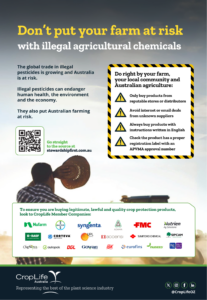
    Don’t put your farm at risk with illegal agricultural chemicals.

    The global trade in illegal pesticides is growing and Australia is at risk. Illegal pesticides can endanger human health, the environment and the economy. They also put Australian farming at risk.


  • Inquiry finds no reason for WA GM compensation scheme

    Comments Off on Inquiry finds no reason for WA GM compensation scheme

    CropLife Australia welcomes the WA Parliamentary Committee inquiry report into Mechanisms for compensation for economic loss to farmers in Western Australia caused by contamination by genetically modified material in which evidence and common sense has prevailed.

    CropLife Australia CEO Matthew Cossey said, “I thank the Standing Committee on Environment and Public Affairs for their work in this inquiry. I’m very pleased, as will be the West Australian farming sector, that the Committee was guided by the evidence and found there is no systemic GM contamination issue in Western Australia and hence no compensation scheme is required.”

    Mr Cossey continued, “This inquiry was brought on by anti-GM activists peddling a solution for a problem that doesn’t exist. What the inquiry has found is there is minimal evidence of contamination by GM crops and absolutely no evidence to suggest that farmers have experienced economic loss because of it.

    “This report again reinforces the critical principle of coexistence in farming which is vital for WA farming to grow and become more sustainable into the future.

    “Farmers are the experts when it comes to coexistence of farming practices, and grain handlers the experts at ensuring sound export, storage and handling practices are followed. Growers and handlers have proven their abilities, they should be left to get on with their jobs.

    “Of most significance is the finding: There is no evidence to suggest that economic loss to farmers caused by contamination by genetically modified material is a widespread or systemic problem in Western Australia.”

    Mr Cossey concluded, “West Australian growers have embraced GM crops since 2010 because of the agronomic, economic and environmental benefits they provide. We look forward to more growers being able to make a choice about growing GM crops without the threat of a costly and unnecessary compensation scheme hanging over their heads.”

    Full report: http://www.parliament.wa.gov.au/env