Denial is not a recovery plan: APVMA’s own data confirms a regulator failing Australian farming
22 October 2026
The national peak industry organisation for the plant science sector, CropLife Australia, is calling for an urgent recovery plan for the Australian Pesticides and Veterinary Medicines Authority (APVMA). It follows an analysis of the regulator’s own data, showing a sustained decline in performance despite a substantially lower workload and increased funding over recent years.
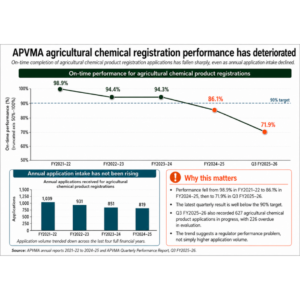
CropLife’s analysis shows APVMA performance has deteriorated in cycles over the past decade. After falling to around 68 to 73 per cent on-time completion between 2015–16 and 2017-18, the regulator recovered strongly, reaching 94 per cent overall and 99 per cent for agricultural chemical product assessments in 2020-21.
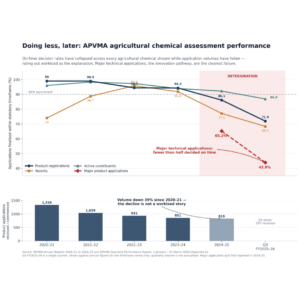
Since 2023–24, performance has deteriorated again, with major application timeframes collapsing, a growing backlog of agricultural chemical product assessments and the abandonment of a pre-application assistance service designed to help prevent delays.
“Just 43.9 per cent of major agricultural chemical applications were completed on time in the March 2026 quarter, according to the APVMA’s own data,” said CropLife Australia Chief Executive Officer, Mr Matthew Cossey.
“At the end of March, more than a third of the 627 product applications in progress were already outside their statutory timeframes. This backlog will continue to drag down performance until it is genuinely confronted.
“These are not just numbers. These are assessments that determine when Australian farmers can access new crop protection technologies, improve productivity and remain competitive.
“The APVMA has previously demonstrated it can deliver on its core functions. It completed 99 per cent of agricultural chemical product assessments on time in 2020–21 and maintained performance above 90 per cent through to 2023–24. Yet today, it is failing to meet its own timeframes on a scale that should alarm its Board, its leadership and the Government.
“On application numbers the regulator is doing considerably less work, considerably slower, with more resources. That is not a workload problem; it is a performance problem.
“This year alone we have seen the APVMA waste its own resources and time, along with the resources and time of industry fixing problems of the Regulator’s own making. It seems they have become experts in ‘make busy’ work that doesn’t deliver better regulatory outcomes or for the nation’s farming sector.
“The APVMA claims this performance is satisfactory. Instead of owning the problem, the APVMA is making excuses and is even late at them.
“For the past two years the APVMA has been buck-passing some of its poor performance onto application quality. Yet its own pre-application assistance service, specifically designed to help applicants prepare better applications and reduce delays, was completed on time in just 17.1 per cent of cases. Now, rather than fixing the service and working with industry to improve application quality, APVMA leadership has chosen to severely restrict it.
“To remove resources from the one legislative tool that supports improving application quality shows a management that is bereft of ideas that will support the agricultural industry in Australia’s national interest.
“The current workload makes the excuses even harder to accept. In 2024-25 it received 819 agricultural chemical product applications, compared with 1,336 in 2020-21, when it completed 99 per cent of product assessments on time.
“An agency with a reputation for rigorous, science-based regulation should be leading the way in transparency, accountability and efficiency. Instead, its leadership appears more concerned with defending and excusing its performance than confronting it.
“No amount of institutional messaging or media spin can make this acceptable. Meeting statutory timeframes (a maximum threshold, not even what the target should be) is a core responsibility of a Commonwealth regulator, not an optional performance target,” said Mr Cossey.
CropLife Australia is calling on the APVMA Board and senior management to acknowledge the scale of the failure and deliver a public, measurable recovery plan that delivers the primary goal set out in Section 1A of its legislation.
“If the Board and senior management cannot recognise or acknowledge that the APVMA’s performance is unacceptable, there is little prospect of the genuine improvement Australian agriculture urgently needs.
“We need a recovery plan with clear milestones for major applications and permits, a credible pathway to eliminating overdue assessments, and transparent reporting against those commitments.
“We also need the APVMA to publish a normalised historical performance dataset by application category, so the industry, government and public can properly assess its performance over time. And we need genuine consultation with industry on the causes of delays and the practical measures required to fix them.
Mr Cossey concluded, “CropLife would like nothing more than to issue a media release congratulating the APVMA on restored performance. The regulator’s own data will tell the nation when that day arrives.
“Until then, denial is not a recovery plan, and Australian farmers deserve better than a regulator that debates its critics instead of clearing its backlog, meets it core obligations and does with even just some nominal efficiency.”
ENDS